// TEND FOR SENIORS · ARTICLE 01
Aging at the center.
What the data actually says about the senior in an American assisted living community — and how TEND is built around that data, point by point.
If you are a family member preparing for a senior care decision, or a community trying to do good work, the most useful place to start is not the brochure. It is the data. The data describes the person at the center: who they are, what they need, what care actually costs, and what catches families by surprise.
At HE 360, our data analytics arm, we have spent the last several years assembling this picture from public sources — CDC, CMS, the Federal Reserve, AARP, KFF, AHCA-NCAL, the VA, and operator-published surveys. The picture is consistent across every state we have looked at. TEND, the senior living network we are launching across the country this summer, state by state, is built directly around what the data says. Every service maps to a specific number on the pages below.
Eight short sections. Four charts. One question underneath all of it: is this senior care system organized around the senior?
01 · WHO THE SENIOR ISThe 80-year-old at the center.
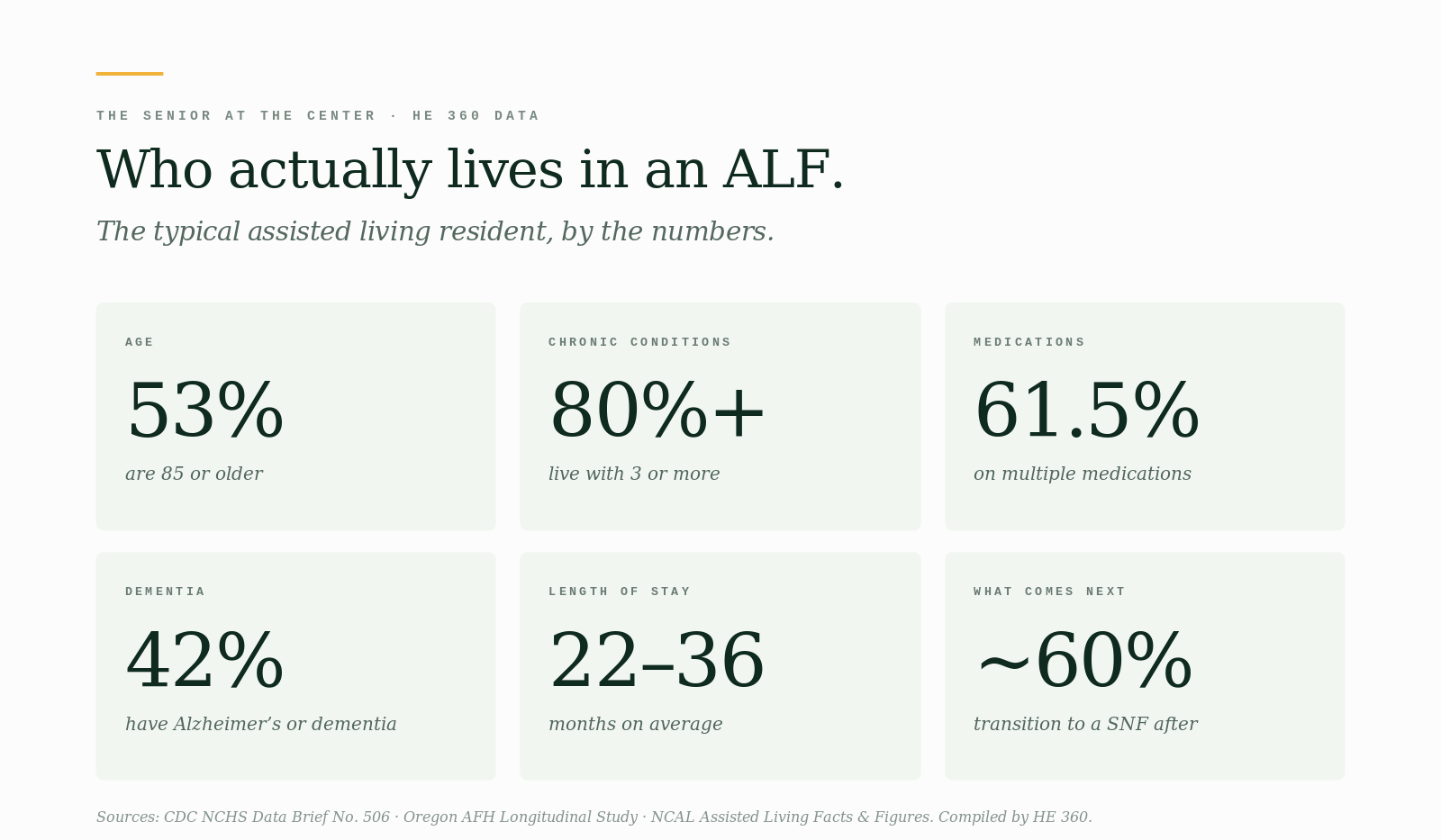
About 58 million Americans are 65 or older today. That number will reach 73 million by 2030 — one in five Americans. Inside formal assisted living, the typical resident is older and frailer than the headline number suggests. Just over half of all assisted living residents are 85 or older. More than eight in ten arrive with three or more chronic conditions. More than six in ten are on multiple medications. More than four in ten are living with Alzheimer’s or another form of dementia.
Sources: CDC NCHS Data Brief No. 506 · Oregon AFH Longitudinal Study · NCAL Assisted Living Facts & Figures. Compiled by HE 360.
This is not the brochure resident. This is the person who arrives in the building — medically complex, often cognitively impaired, frequently in the last few years of life. A typical stay runs 22 to 36 months. Roughly six in ten residents transition into a skilled nursing facility after assisted living. The system has to deliver, in those months, the kind of attention this resident actually needs.
02 · THE MATH NOBODY SHOWS THE FAMILY$70,800 a year on a $200,000 savings account.
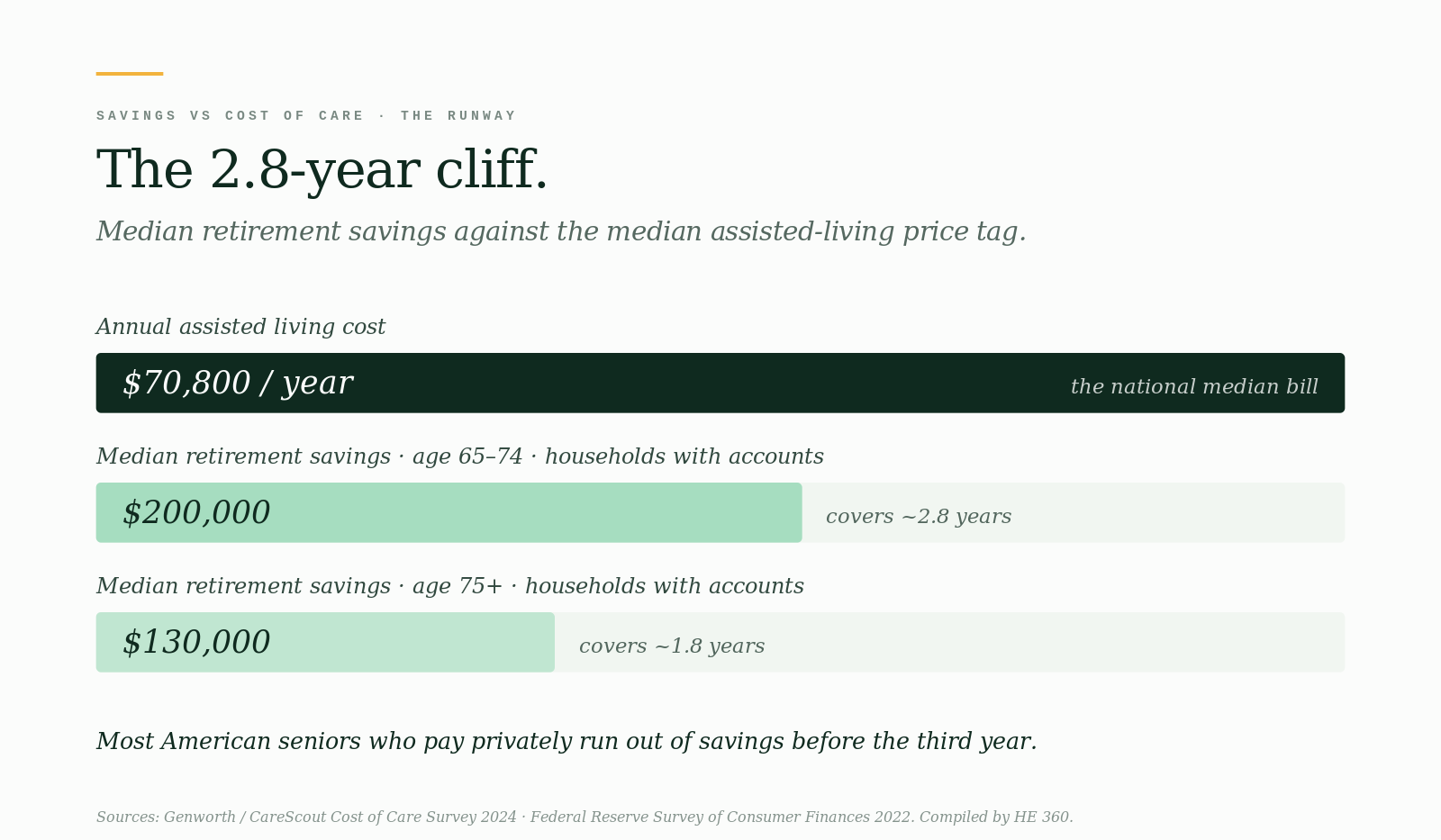
The 2024 Genworth / CareScout Cost of Care Survey put the national median for assisted living at $5,900 a month. That is $70,800 a year. The Federal Reserve’s most recent Survey of Consumer Finances reports that, among American households age 65–74 that hold any retirement account at all, the median balance is roughly $200,000. For 75+ households with accounts, the figure is closer to $130,000. Many senior households have no retirement account; the runway math below applies only to those who do.
The arithmetic is unforgiving even for households that come to the decision with savings. A $200,000 retirement account, applied to a $70,800 annual cost, covers about 2.8 years. For the older subgroup, the runway is closer to 1.8 years. Most American seniors who start out paying privately for assisted living, and who have retirement savings to begin with, run out of money before the third year.
Sources: Genworth / CareScout Cost of Care Survey 2024 · Federal Reserve Survey of Consumer Finances 2022. Compiled by HE 360.
The number that determines a family’s senior care decision is not the monthly rate. It is the runway. Today the runway is invisible at the point of decision.
What TEND does with this data: Find Home, the family-side service that opens this summer, surfaces three numbers for every community in our network — the published monthly base, the typical care-level surcharge for the resident’s clinical profile, and the historical year-over-year escalation rate at that specific community. Families see the runway before they sign.
03 · THE HIDDEN ESCALATIONThe contract is not the price.
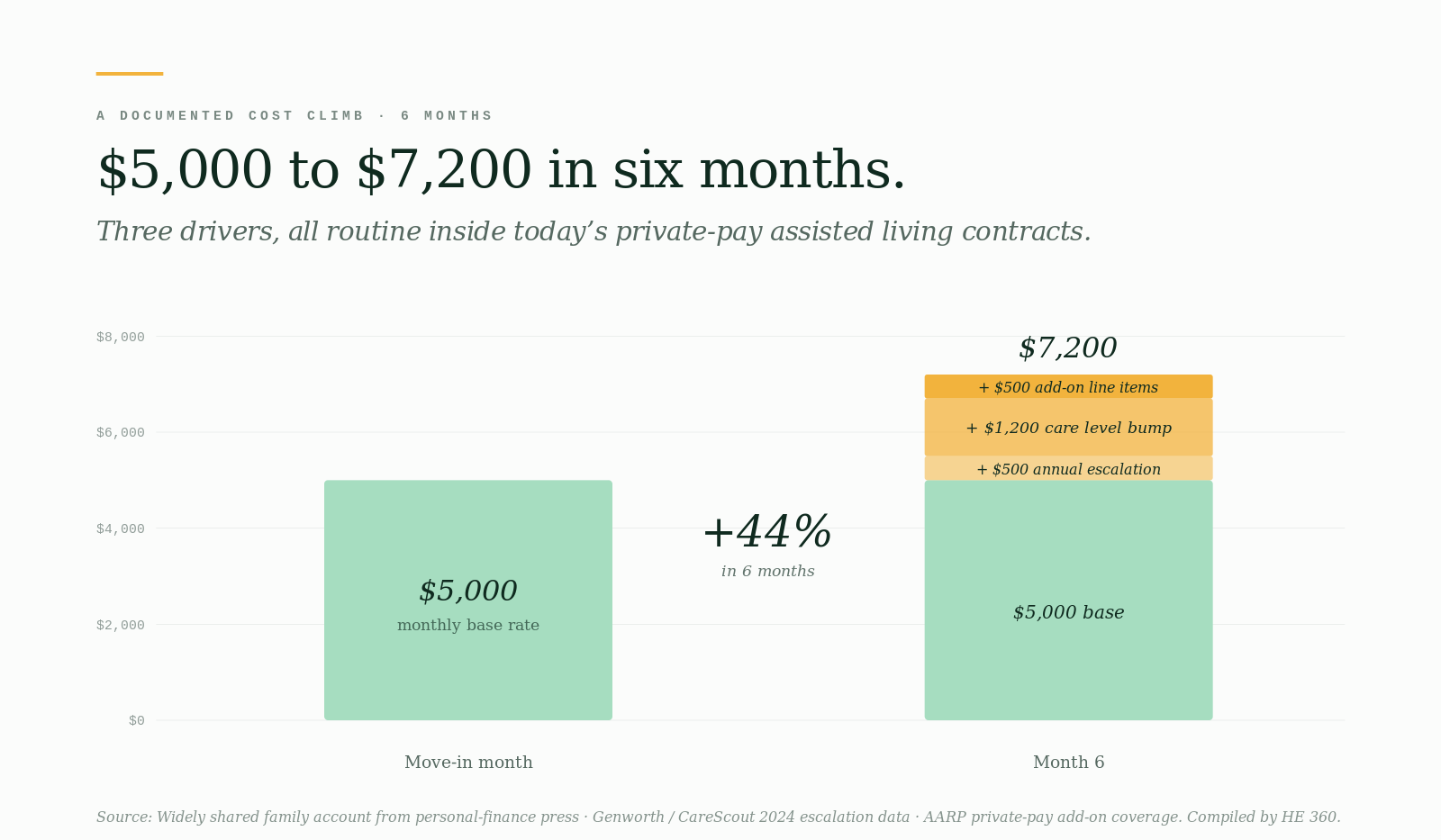
The monthly rate quoted at move-in is the starting line, not the deal. Three escalation patterns are routine inside today’s private-pay assisted living contracts. The first is the annual rate increase, ranging from 3% to 10% per year, with 2024 actuals clustered around the high end. The second is the care-level reclassification — an internal upgrade of the resident’s care plan that adds $500 to $2,000 per month, sometimes within months of move-in. The third is the line-item add-on layer: incontinence supplies, medication management, transport, beauty, extra laundry, second-person assistance — $200 to $1,500 per month, often individually small, collectively decisive.
A widely shared family account from the personal-finance press: a parent moved in at $5,000 a month. By month six the bill was $7,200 a month. Forty-four percent in half a year. None of the three drivers was hidden. All of them were inside the contract.
Sources: Widely shared family account from personal-finance press · Genworth / CareScout 2024 escalation data · AARP private-pay add-on coverage. Compiled by HE 360.
What TEND does with this data: Find Home publishes the typical 12-month escalation trajectory for each enrolled community, not the move-in rate alone. Care Clearance, our 24-hour physician form service, produces a structured care profile that maps directly onto a community’s published care-tier matrix — so the family sees, in advance, which care tier their senior will be classified into.
04 · THE MEDICAID FUNNEL9% of beds.
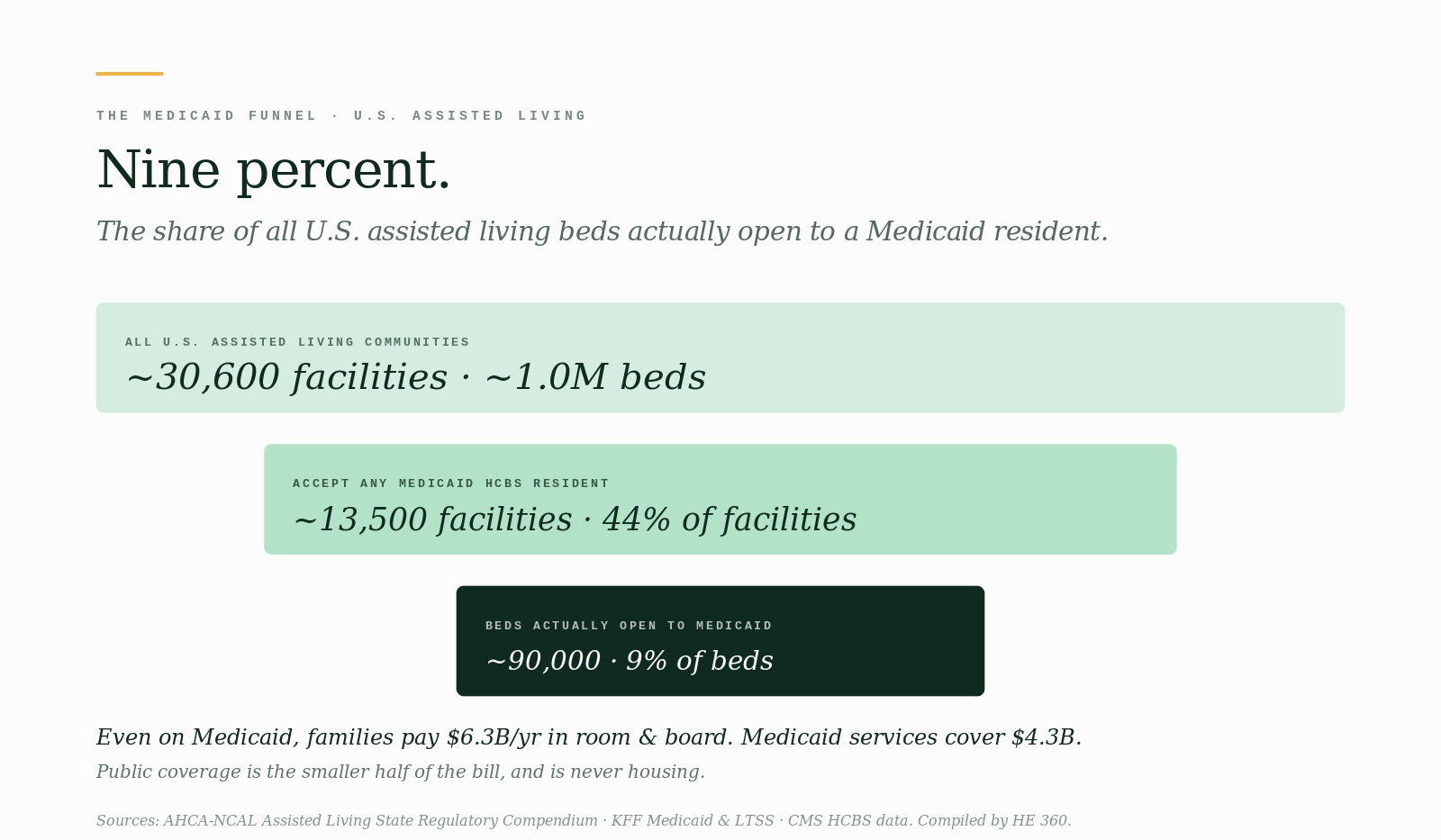
Families often assume that Medicaid is the backstop for assisted living. The data tells a different story. There are roughly 30,600 licensed assisted living communities in the United States, with about a million total beds. Roughly 44% of those communities will accept a Medicaid HCBS waiver resident in principle. But the count of beds actually designated and open to Medicaid residents at any given time is roughly 90,000 — about 9% of all U.S. assisted living beds.
Sources: AHCA-NCAL Assisted Living State Regulatory Compendium · KFF Medicaid & LTSS · CMS HCBS data. Compiled by HE 360.
Even when a senior qualifies for Medicaid and finds one of those 9% of beds, the financial picture is incomplete. Medicaid HCBS in assisted living covers the personal-care services side of the bill — bathing, dressing, medication management, mobility assistance. Medicaid does not cover room and board. Across the country, families and seniors on Medicaid waivers pay an estimated $6.3 billion per year in private room and board. Medicaid services in the same settings cover $4.3 billion. The public coverage is the smaller half of the bill, and is never housing.
Even on Medicaid, the family is still the largest payer at the assisted living door. The public program is a partial subsidy, not a safety net.
What TEND does with this data: Find Home flags Medicaid-accepting communities per state, distinguishes between “accepts new Medicaid” and “converts current residents,” and exposes the room-and-board portion families will still owe. No more arriving at the conversation with the wrong assumption about what Medicaid covers.
05 · THE FORCED MOVEOne in six.
Roughly one in six nursing home residents in the United States enters paying privately and spends down to Medicaid during their stay. The transition is not gentle. When a private-pay resident exhausts savings, the assisted living community frequently does not have an open Medicaid-designated bed; the family is then asked to relocate the senior to a Medicaid-accepting facility, often a skilled nursing home. The move usually happens during the part of life when the resident is least able to absorb the disruption.
The dynamic is structural, not malicious. Communities are operating on margins shaped by private rates. A Medicaid-designated bed pays meaningfully less. The result is that families who chose a beautiful assisted living community at year one find themselves selecting a Medicaid-accepting nursing facility at year three, under time pressure, with the same senior at the center who has now been through one move too many.
06 · THE FIVE-YEAR TRAJECTORYWhat families discover, in order.
Put the documented escalation rate against the median starting bill and the arithmetic does the rest. The 2024 Genworth survey’s observed year-over-year increase in private-pay assisted living rates ran near 10%. Apply that, plus a typical care-level reclassification inside the first 18 months, to a baseline budget:
| Year | Expected cost | Financial milestones & realities |
|---|---|---|
| Year 1 | $70,800 | Initial private-pay entry. Median savings sit at $200,000. |
| Year 2 | $77,880 | 10% annual escalation + care-level reclassification tier-up. |
| Year 3 | $85,668 | The spend-down cliff. Total cumulative cost hits ~$234,000. Median savings are entirely exhausted. |
| Year 4+ | Medicaid funnel | Forced relocation conversation to a Medicaid-accepting skilled nursing facility. |
This is not a TEND forecast. It is what the published industry data does to a typical budget when you carry it forward year over year. The brochure shows the move-in number. The data shows the trajectory.
The most expensive part of the senior care decision is not made at the move-in conversation. It is the avoidable forced move in year four — the one no one saw coming, the one the data could have predicted.
07 · WHAT TEND DOES DIFFERENTLYOne network, six dimensions, the senior at the center.
TEND is organized around the proposition that the family deserves to see the picture that the data has been describing all along. Six dimensions of the senior care decision — clinical fit, safety record, lifestyle, social environment, support services, and financial trajectory — should be visible per-community, not promised in the abstract.
FAMILY SIDE
Find Home. Vetted communities by state, care tier, and budget. Published base rates, typical surcharges, historical escalation, Medicaid status, and the runway.
FAMILY SIDE
Care Clearance. Physician-signed senior care admission forms in 24 hours, rolling out state by state — the form that holds up admissions today, closed in a day.
FAMILY SIDE
Tend Home. A TEND-branded family portal that works at any enrolled community. One place for updates, medications, meals, visits, and concerns.
COMMUNITY SIDE
We Assist with Medications. eMAR, pharmacy coordination, audit trail. Compliance documentation that travels with the resident.
COMMUNITY SIDE
We Run Virtual Care + Front Desk. Resident assessments, care plans, staffing coordination, food service, activities — the operations layer delivered with consistency.
Underneath both sides sits the HE 360 data layer that produced this article. Every Care Clearance generates a structured care profile. Every community in the network publishes its operational consistency. Every Find Home match contributes outcome data. Over time, TEND is designed to publish a cross-state senior care outcomes layer that the current market does not yet assemble.
The work above is the editorial picture of where the system stands. The work below it — what TEND will publish per-community, what families will be able to see before they sign, what communities will be able to demonstrate when they enroll — is what TEND will share in the next set of articles as each piece goes live.
08 · THE INVITATIONAcross the country, state by state. Summer 2026.
For families
If you are navigating senior care now, or expect to within the year, the waitlist is open in all 50 states. You will be notified the day Care Clearance and Find Home open in yours.
For communities
If you operate an assisted living or memory care community and you want to be on the network that publishes the picture above, partner with us.
For policy and analysis
The cross-state senior care outcomes data layer we are building will matter to anyone working in senior policy, clinical operations, or healthcare analytics. Let’s have the conversation.